



Introduction
A Go compiler built on MLIR and LLVM. Keep your Go code, switch the compiler, and get small native executables.
marmot compiles Go programs to native executables through MLIR and LLVM. It works like the
go command: run it inside a Go module, with the same packages, flags and tests.
marmot build ./cmd/app             # fast rebuilds
marmot build -release ./cmd/app    # whole program optimization
marmot run main.go
marmot test ./...
Status: experimental
marmot compiles real Go programs, including itself, but it is new and not ready for production use. See Support for what works and what does not.
Why marmot
- Small binaries. A hello world with
printlnis 148 KB in release mode, against 1.68 MB fromgo build. Withfmt.Printlnit is 665 KB against 2.4 MB. - Fast programs. Release builds run 1.6x faster than Go on average over 43 programs, with every program's output checked against Go.
- Fast builds. A rebuild with nothing changed takes 0.05 to 0.07 s on a 238 package program, against 0.14 to 0.15 s.
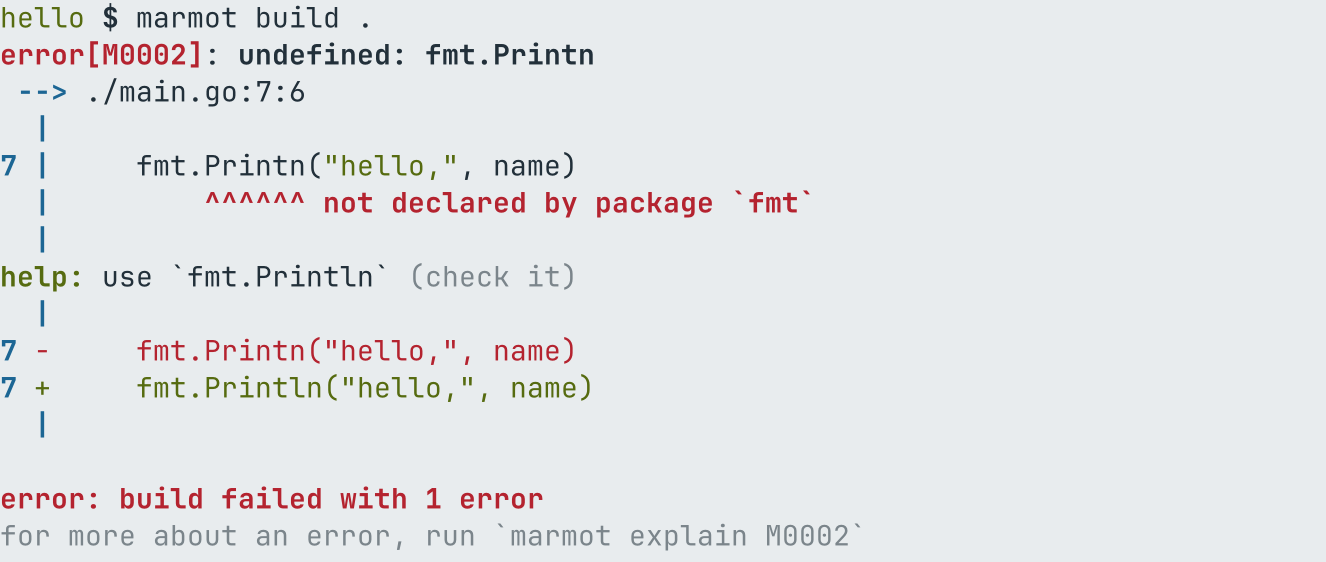
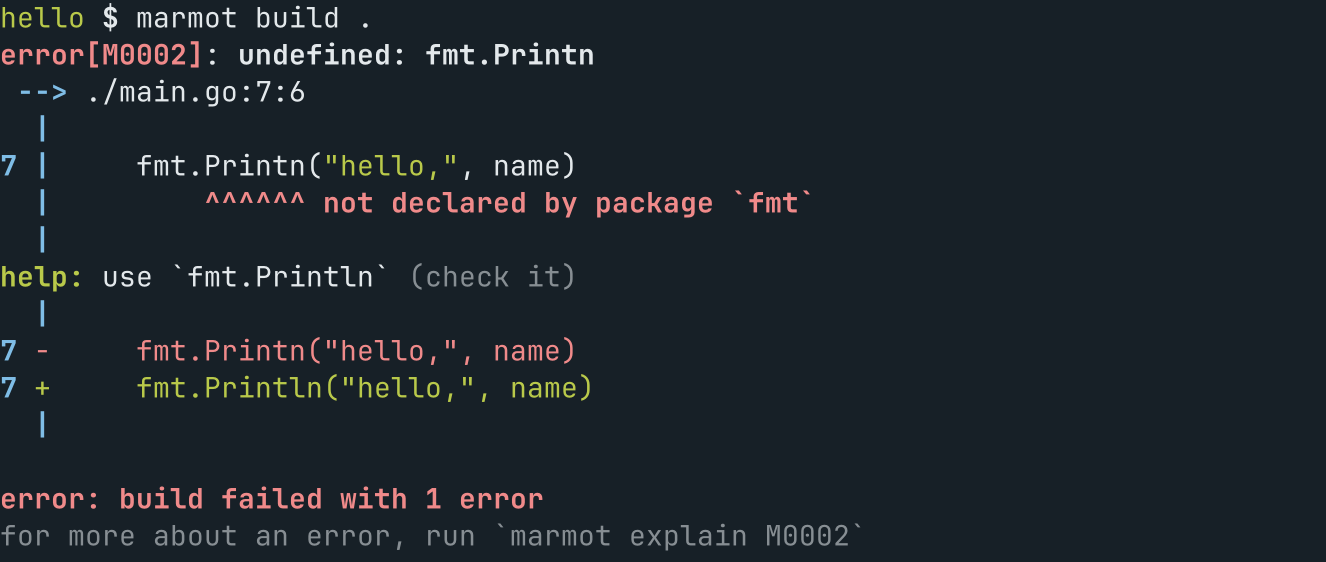
- Errors that teach. Every error shows the source, the exact span, a label that says what
is wrong there, and a suggested fix that
marmot fixcan apply. Coding agents get the same information as JSON.
The tools you install next to go
marmot also does what people usually install separate tools for: marmot fmt (goimports),
marmot check (vet, golangci-lint, govulncheck, tidy and more, in one pass), marmot fix,
marmot watch, marmot repl, marmot bench (benchstat built in), marmot prof (pprof in the
terminal), marmot size, marmot generate with a cache, marmot doctor, and marmot mcp for
coding agents. See Commands.
How it works
marmot keeps the parts of the Go toolchain that define the language (the go/types checker,
the SSA builder, Go's own standard library source) and replaces the parts that generate code.
Design explains each step.
The name
A marmot is a close relative of the gopher, and it starts with M, like MLIR. Marmots stand guard on a rock and whistle when something is wrong, which is what marmot's error messages are for.